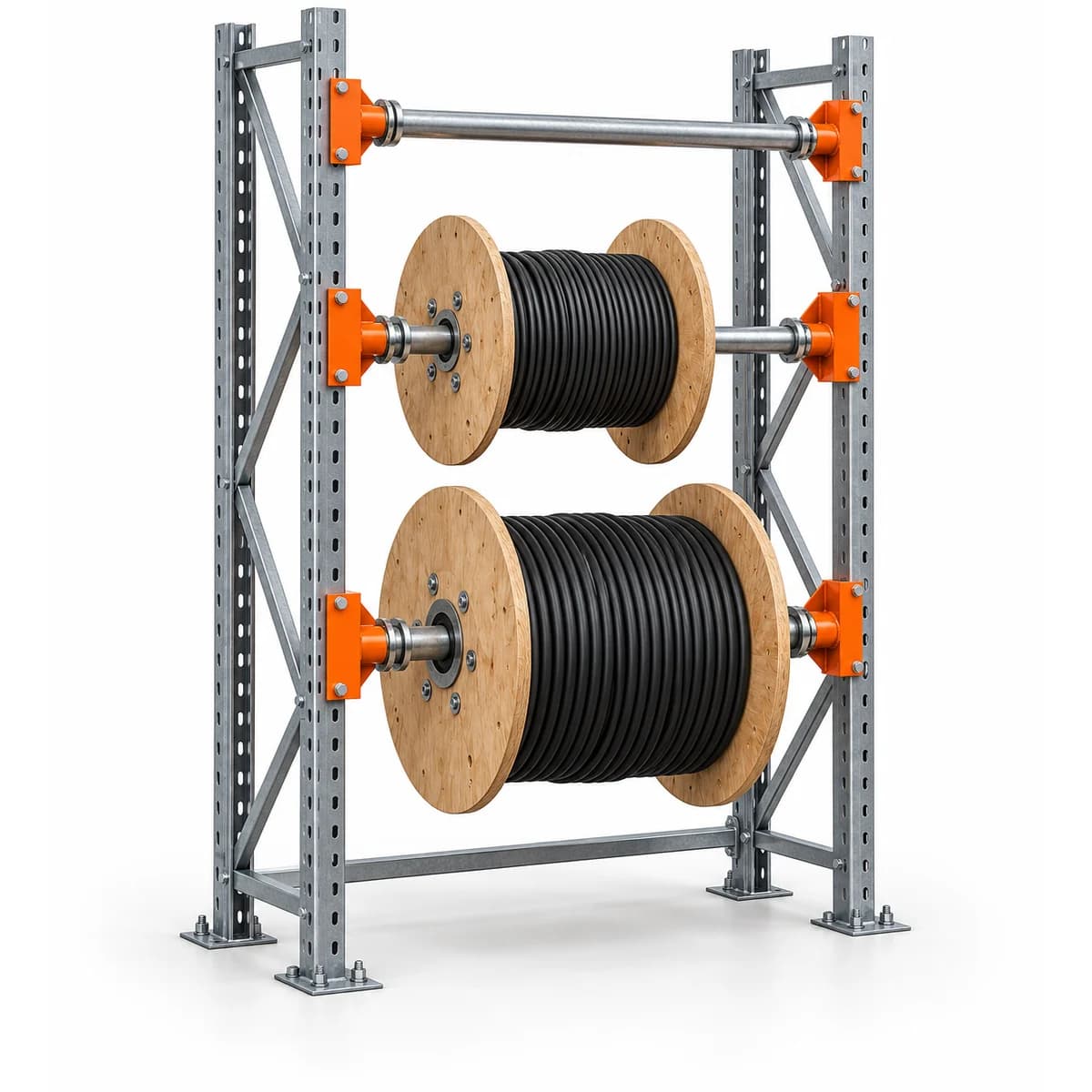
Catalogue by function, not appearance
The warehouse-equipment shop combines complete racking bays, structural components, profiles, decking, containers, protection, handling equipment and service work. Sections follow each item's role in the project so users do not confuse a load-bearing part, an accessory and a complete system. Product records identify item number, series, subtype, dimensions, coating, supply unit and compatible systems. Matching length or colour does not prove interchangeability. If an item affects the structural scheme, its suitability is checked against the project and manufacturer documentation before it enters the final specification.
Complete bays and components
A standard bay is selected by the actual load, level count, span and required capacity and then checked against available height and aisle width. Frames, beams, shelves, arms, bracing, supports and connectors belong to a defined series and connection. A profile length may be configured in set increments, but changing length does not automatically preserve the previous capacity. Product records do not invent loads or claim universal compatibility; unverified characteristics are flagged for review. This reduces the risk of ordering a visually similar part that does not match the configuration or revision of the installed racking.
Containers, protection and handling equipment
Containers, cartons, pallets and trays are selected by internal and external dimensions, weight, stacking and handling method. Protection for row ends, uprights, columns and pedestrian zones must address the likely impact direction without reducing the working aisle below its minimum. Trolley, stacker and forklift selection considers capacity at the required height, residual capacity, Ast, turning radius, floor type and charging regime. Handling equipment affects the entire layout and cannot be treated as an isolated purchase after design completion. Compatible items are linked to the order and checked with the calculated system.
Price, availability and delivery terms
A fixed price is possible only for a confirmed configuration and a current price list. Engineered systems, variable lengths, installation and delivery are priced by quantity, region, schedule and site conditions. The interface distinguishes stock supply, manufacture and quotation requests. The request scope preserves the selected variant and quantity, but the total is not final until price and mandatory characteristics are verified. The manager confirms compatibility, lead time and logistics, and every specification change creates a new revision.
From request scope to order request
Shop items are combined with the calculation and warehouse plan. Variants, quantities and sources enter the request, and the client adds deadlines and site constraints. The manager assigns the designer, warehouse employee and installer, attaches documents and agrees the price. The designer uploads the specification, the warehouse uploads acceptance photos and the installer uploads the completed result, defects or shortages. The history links supplied products to the project and preserves context for repair or expansion.